PhD in Global Theological Education
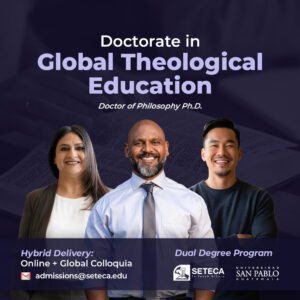
Ph.D. in Global Theological Education (English)
The PhD in Global Theological Education (PhD GTE) equips academic leaders committed to strengthening the formation offered by colleges and training programs across the Majority World, with particular attention to Asia, Africa, and the Caribbean. It serves presidents and rectors, deans and program directors, seminary faculty, and trainers in non-formal contexts.
Building on more than two decades of SETECA’s Spanish-medium doctorate in theological education, this English-medium program is developed in collaboration with partners from across the ICETE network—context-sensitive by design and shaped by the actual needs of global theological education.
Doctor of Philosophy
English language program
Hybrid: Online + Global Colloquia
Mode of instruction
Approximately
4 years
Duration
PROGRAM DESCRIPTION
The PhD GTE develops educational leaders capable of designing and leading programs of theological education that respond biblically and missionally to the needs of the Church. It equips a growing cadre of theological educators with broad competencies in culturally informed pedagogy, context-rooted curriculum development, holistic formation, and educational leadership, preparing innovators to strengthen missional theological education in service of the global Church in the twenty-first century.
What Makes This Program Distinctive?
- Rooted in the Majority World. Not a Western program exported elsewhere. The PhD GTE is conceived by and for theological educators in Africa, Asia, the Caribbean, and beyond, in consultation with ICETE’s regional associations.
- Focused specifically on theological education. Every course, assignment, and conversation is oriented toward forming Christian leaders for the Church and its mission.
- Online and accessible. Pursue doctoral studies without leaving your institution, your ministry, or your family. The program is designed for affordability and flexibility, with colloquia for face-to-face engagement.
- Practitioner-oriented. A program for those doing the work, not only studying it. Practicums, problem-based learning, and a Portfolio of Practice ensure that your studies serve your ministry from the first semester onward.
- A global learning community. Study with faculty and peers from across the Majority World, learning from one another’s contexts. The relationships formed here will sustain your leadership for years to come.
- Aligned with ICETE standards. Built on the Beirut Benchmarks, the SG-GETE, and the ICETE Manifesto II, your degree is recognized across the global evangelical theological education network.
METHODOLOGY
The PhD GTE follows a hybrid delivery model: online coursework combined with face-to-face global colloquia. The program has three components: the common curriculum, the dissertation or project, and the Portfolio of Practice.
- The common curriculum consists of six core courses offered over three years, two per semester. Students work from their place of residence, engaging coursework online through active participation, problem-based learning, and other innovative methodologies. A comprehensive examination completes this phase before students advance to the dissertation or project.
- The Portfolio of Practice ensures that graduates are competent practitioners, not only theorists. Candidates demonstrate practical teaching skills and build a repository of renewable educational resources for ongoing ministry use.
- The Global Colloquia—four in total, two credits each—combine collegial networking, spiritual and academic mentoring, research methodology, and peer engagement on research progress with focused seminars on Bible, theology, education, and contextual awareness. Colloquia rotate among regions of the Majority World, with cost, visa accessibility, and geography considered in each year’s location. Visits to local theological schools further enrich the experience.
PROGRAM STRUCTURE
120 ECTS / CLAR credits
Credit distribution:
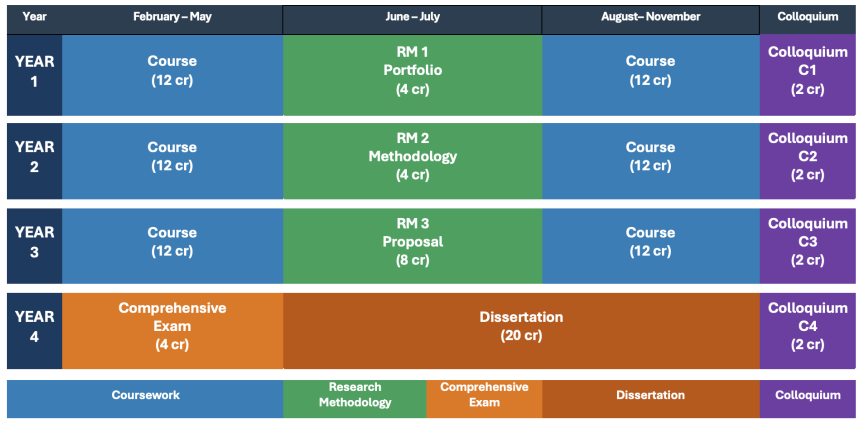
Coursework 6 × 12 = 72 · Research Methodology 4 + 4 + 8 = 16 ·
Comprehensive 4 · Dissertation 20 · Colloquia 4 × 2 = 8 · Total = 120
GRADUATE PROFILE
The PhD GTE graduate profile is structured around the seven Beirut Benchmarks for doctoral programs, endorsed by ICETE and integrated into the Standards and Guidelines for Global Evangelical Theological Education (SG-GETE). These benchmarks describe the qualities expected of doctoral graduates within an evangelical Christian institution, where acquiring and exercising wisdom involves a combination of faith, reason, and action.
1.Comprehensive Understanding of Field
2.Critical Skills, Faithfully Exercised
3.Serious Inquiry with Integrity
4.Creative and Original Contribution
5.Contextual Relevance
6.Effective Communication
7.Missional Impact
The PhD GTE develops each of these benchmarks into specific program competencies, with indicators and evidence drawn from coursework, the comprehensive examination, the Portfolio of Practice, the dissertation or project, and other elements of the program. The full graduate profile—mapping each benchmark to its corresponding competencies, indicators, and evidence—is set out in the Program Prospectus and in the syllabi of each course.
WHO SHOULD APPLY
The PhD GTE is designed for those serving—or preparing to serve—as theological educators, academic administrators, program directors, or institutional leaders. You may be a dean seeking to strengthen your school’s curriculum, a professor wanting to deepen your understanding of how adults learn and how culture shapes the classroom, or the leader of a non-formal training program seeking greater rigor and intentionality in your work. Whatever your role, the PhD GTE is for practitioners who want to grow as educational leaders while remaining rooted in your ministry.
ESTIMATED PROGRAM COSTS
All amounts in U.S. dollars (USD). Travel and graduation costs are estimates and may vary by location, year, and personal circumstances. «Recommended» indicates suggested spending; students may adjust based on use of library and online resources.
Total Cost | Per Semester | Per Year | |
Admissions Fee (one-time) | $55.00 | — | — |
Tuition (courses and dissertation) | $15,900.00 | $1,987.50 | $3,975.00 |
Colloquia Travel (estimated) | $6,000.00 | $1,500.00 | $1,500.00 |
Graduation Fee (one-time) | $280.00 | — | — |
Academic Regalia (optional) | $600.00 | — | — |
Graduation Travel (estimated) | $1,700.00 | — | — |
Books (recommended) | $1,200.00 | $150.00 | $300.00 |
Program Total | $25,735.00 | $3,216.88 | $6,433.75 |
YOUR DOCTORAL JOURNEY
Over the course of four years, you will work through six core courses, three research methodology courses, four Global Colloquia, a comprehensive examination, a Portfolio of Practice, and a final dissertation or project. Each element is designed to deepen your formation as an educational leader.
Six Core Courses
- Technology and Theological Education. Explores how emerging technologies—including digital pedagogies, hybrid learning models, and artificial intelligence—shape the theory and practice of theological education. You will develop frameworks for integrating technology in ways that are pedagogically rigorous, missionally attentive, and contextually aware.
- Educational Psychology and Teaching Practice. Investigates the psychological foundations of teaching and learning, drawing on contemporary research in cognition, memory, motivation, and the neurology of learning. Practical training in workshop leadership, instructional consulting, and faculty development equips you to guide colleagues in pedagogical improvement.
- Culture, Society, and Theological Education. Examines how culture shapes learning, identity formation, and meaning-making, engaging sociological, anthropological, and political perspectives on theological education. You will develop frameworks for culturally responsive teaching and institutional leadership that promote justice, equity, and faithful formation.
- Curriculum Design and Formation. Explores the theory and practice of curriculum design, including course and lesson design, instructional design models, assessment, and Universal Design for Learning. Emphasis is placed on context-rooted curricular engagement that supports holistic formation toward maturity in Christ.
- Theology of Theological Education. Investigates the theological foundations of theological education, examining how the biblical metanarrative shapes educational philosophy and pedagogical commitments. Particular emphasis is placed on a missional-ecclesial vision of theological education as participation in God’s redemptive work.
- Educational Leadership. Examines the theory and practice of educational leadership in theological institutions and non-formal training programs, including the cultivation of healthy institutional culture, culturally sensitive governance, and the dynamics of power, accountability, and the prevention of abuse. You will grow in your capacity to lead institutions marked by integrity, justice, and holistic formation.
Research Methods
Three Research Methodology courses prepare you for the Portfolio of Practice and the final Dissertation or Project: shaping the portfolio (RM 1), surveying research approaches (RM 2), and developing the formal proposal (RM 3).
Global Colloquia
The curriculum includes four annual five-day Global Colloquia (two credits each), combining collegial networking, spiritual and academic mentoring, advanced research methodology, and peer engagement with focused seminars on Bible, theology, education, and contextual awareness. Colloquia rotate among regions of the Majority World, with cost, visa accessibility, and geography considered in each year’s location.
Comprehensive Examination (Candidacy Examination)
Following the completion of coursework, you will sit a candidacy examination demonstrating mastery of the program’s interdisciplinary focus and your ability to integrate educational topics with theology. Those who pass receive a certificate as «Candidate for the PhD in Global Theological Education.»
Portfolio of Practice
The Portfolio of Practice is a curated collection of artifacts and reflective analysis that demonstrates your reflective competence, professional growth, and educational impact across multiple domains. The strongest portfolios include renewable resources that serve your ongoing ministry and the wider community of evangelical theological education.
Dissertation / Project
Your doctoral journey culminates in a dissertation or project: a sustained piece of original research that addresses a real challenge or opportunity in theological education. The dissertation constitutes 20 credits and is a required component of the program.
Further information on each course and program element is available in the Program Prospectus and the course syllabi.
PROGRAM REQUIREMENTS
Applicants to this program must meet the following requirements:
1.A master’s degree (or another postgraduate level) that aligns with the focus of the doctoral program offered. Exceptional cases will be considered by the GTE Team. Applicants who do not hold a postgraduate degree in Bible/Theology must hold an undergraduate degree in Bible/Theology. Applicants who hold an undergraduate or postgraduate degree in Education may be required to complete additional Bible and Theology courses before being accepted into the program.
2.Official transcripts of previous studies (official certification: list of courses taken and grades earned) for the undergraduate (bachelor’s or equivalent) and postgraduate (master’s or equivalent) degrees.
3.Three years of full-time teaching experience (or its equivalent) at a seminary, Bible institute, or non-formal training program, and three years of additional Christian ministry experience, which may have been carried out simultaneously.
4.A curriculum vitae (CV) documenting academic credentials, teaching experience, ministry experience, publications, and other relevant professional activities.
5.Advanced knowledge of English, demonstrated either as a native language, through the completion of prior studies in English, or through a TOEFL iBT total score of 80 or higher.
6.Additional written components as described on the Admissions Form:
- Personal history/testimony
- An essay explaining why you wish to enter the program and what your goals are in connection with it
- Aspects of your person and ministry
- A sample of written or published work that demonstrates competency in academic writing
7.Four letters of recommendation from the following persons (who must not be family members). List the names, positions, and addresses on the application and then prepare the individual forms to be distributed.
- an immediate supervisor
- a colleague
- a friend (or a professional who knows you well)
- your pastor
8.A letter of endorsement and commitment from the sponsoring institution.
9.A signed endorsement from the regional association of ICETE or equivalent denominational leadership. This will be on a form provided by SETECA.
10.A signed statement of agreement with the financial policy of SETECA.
11.A signed statement of agreement with the doctrinal statement of the World Evangelical Alliance.
12.Admissions processing fee of USD $55.00.
The forms must be returned to the Director of Admissions, SETECA (admissions@seteca.edu).

STATEMENT OF FAITH
The PhD GTE adopts the Statement of Faith of the World Evangelical Alliance (WEA). All students and faculty affirm the following:
We believe in:
- The Holy Scriptures as originally given by God, divinely inspired, infallible, entirely trustworthy; and the supreme authority in all matters of faith and conduct.
- One God, eternally existent in three persons, Father, Son and Holy Spirit.
- Our Lord Jesus Christ, God manifest in the flesh, His virgin birth, His sinless human life, His divine miracles, His vicarious and atoning death, His bodily resurrection, His ascension, His mediatorial work, and His personal return in power and glory.
- The Salvation of lost and sinful man through the shed blood of the Lord Jesus Christ by faith apart from works, and regeneration by the Holy Spirit.
- The Holy Spirit by whose indwelling the believer is enabled to live a holy life, to witness and work for the Lord Jesus Christ.
- The Unity of the Spirit of all true believers, the Church, the Body of Christ.
- The Resurrection of both the saved and the lost; they that are saved unto the resurrection of life, they that are lost unto the resurrection of damnation.
ADVISORY BOARD AND BOARD OF REFERENCE
The PhD in Global Theological Education team is committed to sustaining strong connections with senior leaders in theological education across the Majority World. To this end, we are guided by two bodies of senior colleagues: an Advisory Board and a Board of Reference. The Advisory Board brings together experienced specialists in global evangelical theological education, who help shape the program’s design and delivery. The Board of Reference brings together senior leaders who advocate for and support the PhD in GTE across the global Church.
Advisory Board
- Dr Seblewongel Asrat Denneque, Counseling Director, CURE Children’s Hospital, Ethiopia.
- Dr Saskia Donner, Academic Dean, Fundación Universitaria Seminario Bíblico de Colombia.
- Dr Joanna Feliciano-Soberano, Educational Consultant, Mesa Global.
- Dr John Kpaleh Jusu, Theological Education Consultant – Anglophone Africa, Mesa Global.
- Dr Bennet Lawrence, Regional Secretary, Asia Theological Association – India.
- Dr Rosalind Lim-Tan, Director, Education Programs, Asia Graduate School of Theology (Alliance).
- Dr César Lopes, President, Comunidad de Estudios Teológicos Interdisciplinarios (CETI).
- Dr Nativity Petallar, Associate Dean for Doctoral Studies, Asia-Pacific Nazarene Theological Seminary.
Board of Reference
- Dr Elias Ghazal, Executive Director, Middle East Association for Theological Education (MENATE).
- Dr Evan Hunter, Executive Vice President, ScholarLeaders.
- Dr Errol E. Joseph, Accrediting Coordinator, Caribbean Evangelical Theological Association.
- Rev Dr Riad Kassis, International Director, Langham Partnership International.
- Dr Bennet Lawrence, Regional Secretary, Asia Theological Association – India.
- Dr Theresa Roco Lua, General Secretary, Asia Theological Association (ATA).
- Rev Dr David Tarus, Executive Director, Association for Christian Theological Education in Africa (ACTEA).
Want to learn more? Get in touch.
Email: admissions@seteca.edu
WhatsApp: +502 4740-3665
Phone (Main Office): +502 2462-5858
Address: Avenida Bolívar 30-42, Zone 3, Guatemala City, Guatemala
Office hours: Monday–Friday, 8 a.m.–5 p.m. (Central Standard Time, UTC-6).